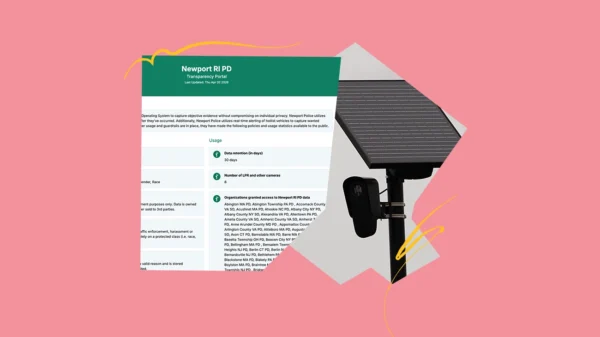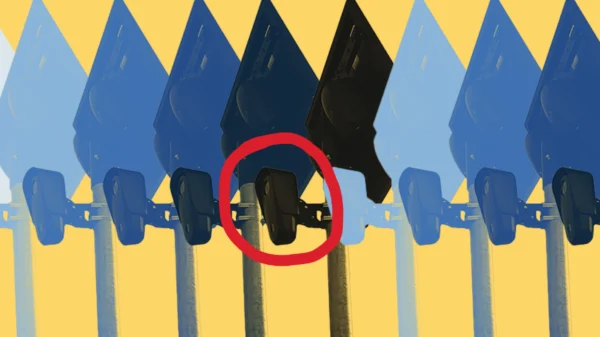
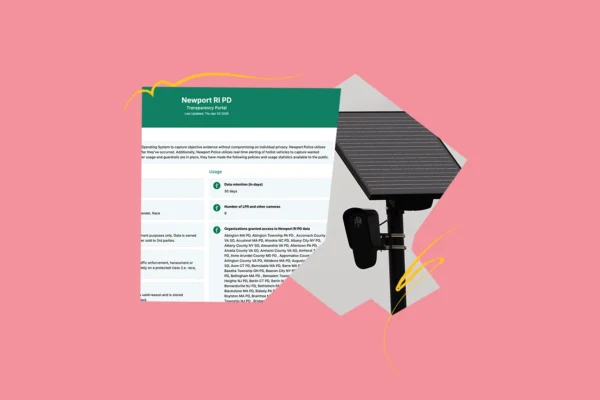
Contrary to claims by Flock Safety and local police departments that their use of Flock Safety surveillance cameras is transparent, a recent ACLU of RI investigation reveals a quite different reality. Instead, the ACLU found that the company makes intentional choices to shield their past operational and privacy claims from independent verification, and many local police departments do not post important data on their “transparency portals” — public pages with statistics about their automated license plate reader (ALPR) camera use.
The civil liberties organization called out these opaque practices to highlight the lack of information that the public can access about the powerful surveillance network made up of about 280 cameras across the state, the use of which municipalities are reconsidering due to significant privacy concerns raised by the ACLU and local residents.
Transparency portals list information about a given city or town’s use of Flock Safety ALPR cameras, with different categories that the police departments can choose to provide or not. This can include how many cameras are installed, how many license plates have been read in a given timeframe, how many searches of the data have been made, and the reasons for the searches. Outside of public records requests to individual police departments that can be costly and time consuming, the information on these portals is the only way of knowing, among other things, the extent to which other law enforcement agencies have access to a police department’s camera system data.
However, as of early September, the transparency portals of at least six municipalities did not list which other police departments or other agencies they shared their information with, and nearly every police department failed to indicate what agencies they receive surveillance data from. In addition, Coventry and the Rhode Island State Police fail to have a public portal listed at all.
The municipalities that do not list what agencies they share data with are:
- East Providence
- Johnston
- Newport
- North Providence
- Pawtucket
- Smithfield
The municipalities that do not list what agencies they receive data from are:
- Central Falls
- Cranston
- Cumberland
- East Providence
- Glocester
- Johnston
- Narragansett
- North Kingstown
- North Providence
- Pawtucket
- Providence
- Smithfield
- South Kingstown
- Tiverton
- Warwick
- West Greenwich
- Woonsocket
The ACLU of RI also noted that all of Flock Safety’s online presence, including the links to every transparency portal, has been deliberately excluded from the Internet Archive’s Wayback Machine, a website that allows users to see snapshot images of earlier versions of websites across the internet. When searching for a transparency portal or simply a previous version of Flock Safety’s website, users see a message that “This URL has been excluded from the Wayback Machine.” As a result, the company is able to hide how their policies and talking points have evolved over time. For example, the company updated their terms of service to include a “perpetual license” over the data generated by these cameras, and there is no way to compare to previous policies posted on their website. The ACLU of RI cited other reports confirming that Flock Safety has opted itself out from this internet resource, and that it has also taken steps to limit access by the public to audit logs that can provide documentation of misuse of the system by police officers.
Madalyn McGunagle, policy associate at the ACLU of RI, said today: “Flock Safety is intentionally preventing concerned citizens and watchdog organizations from seeing how their company and offerings change and how police department transparency portals evolve over time.” She added: “We were also disappointed to find that so many municipalities do not choose to provide all the information on their transparency portals that is easily available for public disclosure. When privacy is on the line, it’s critical police departments are as public as possible with their communities about how these cameras are being used.”
This lack of transparency, the ACLU argued, offers another reason why Rhode Island communities should continue rejecting the use of these surveillance devices. A blog post by the ACLU of RI that raises additional concerns about non-transparency in use of the cameras can be found here.