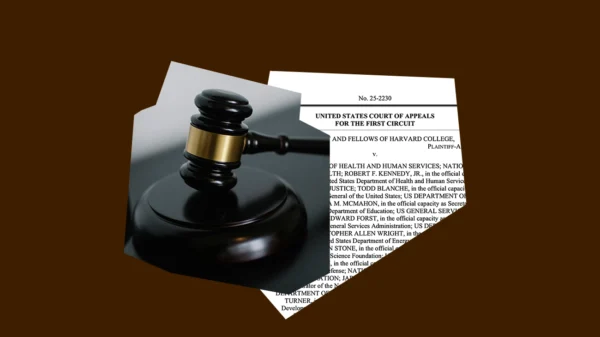
Today, the ACLU of RI joined legal organizations across the ideological spectrum to urge the United States Court of Appeals for the First Circuit to uphold a district court’s order blocking the Trump administration’s attempted hostile ideological takeover of Harvard University.
The federal government decided to withhold billions of dollars in research funding from Harvard University after the university refused to vet its students, faculty, and course offerings for “ideological diversity” and place certain departments and centers at odds with the government’s preferred viewpoint – such as the Department of Near Eastern Languages and Cultures – under a third party audit.
On June 9, 2025, the ACLU and numerous other organizations filed an amicus brief in support of Harvard’s motion for summary judgement. On September 3, 2025, the federal court in the District of Massachusetts blocked the government’s attacks on Harvard. The judge noted that the Trump administration tried to “force Harvard to better manifest the government’s favored worldview,” in direct violation of the university’s right to free speech.
Today, the following organizations, together filed an amicus brief asking the appellate court to affirm the lower court’s ruling that the administration's actions are unconstitutional:
- ACLU
- ACLU of Massachusetts
- ACLU of Maine
- ACLU of New Hampshire
- ACLU of Puerto Rico
- ACLU of Rhode Island
- Cato Institute
- Electronic Frontier Foundation
- Knight First Amendment Institute
- National Coalition Against Censorship
- Reporters Committee for Freedom of the Press
- Rutherford Institute
The brief’s key arguments:
- “The administration’s conduct is unconstitutional any way you slice it: It represents an effort by this administration to impose ‘its own conception of speech nirvana’ on a private institution . . . ; it improperly seeks to leverage federal research funds in a viewpoint-based way, to control speech outside of the scope of the program, and to control the work of a private university—each of which is unconstitutional in its own right.” The government sought to unconstitutionally coerce Harvard to hire faculty, admit students, and make research choices that aligned with the government’s preferred ideological tilt, a viewpoint-based condition for funding that is unconstitutional.
- “The First Amendment principle of academic freedom prohibits the government from imposing ideological admissions, hiring, and programmatic requirements on colleges and universities.” The First Amendment retaliation and coercion in this case is all the more egregious because it targets an institution of higher education, whose choices about who to teach, what to teach, and who should do the teaching are all protected by the First Amendment.
QUOTES
“The ACLU of Rhode Island is proud to stand with the organizations from across the public, cultural and political spectrum who are all aligned in their opposition to the federal government’s effort to leverage federal grants to coerce and intimidate private colleges and universities to abandon that most fundamental space for free thought and expression that higher education represents and instead step in line with the administration’s ideological viewpoints,” said Lynette Labinger, Cooperating Attorney for the ACLU of Rhode Island. “As we say in our brief, ‘Allowing the administration’s unlawful conduct here could open the floodgates to retaliation, coercion, and ideological bullying of private actors across sectors.’”
“The government’s abuse of its funding power here is meant as a message to all of us: get in ideological line or the government will go after you,” said Vera Eidelman, senior staff attorney with the ACLU. “This ideological bullying is an abuse of the executive’s power, and the appellate court should affirm that it violates the First Amendment, or the floodgates of retaliation and coercion will open to us all.”
"The Trump administration's attempt to bully Harvard into submission is a brazen attack on free expression and academic freedom, which are essential pillars of our democracy," said Jessie Rossman, legal director at the ACLU of Massachusetts. "Universities are places of free inquiry, where scholars expand their horizons, advance science and knowledge, and enrich our culture. Academic institutions are part of the bedrock of Massachusetts, and residents of the Commonwealth understand that we all lose if such attacks go unchallenged. Now more than ever, it is critical that institutions exercise the courage to fight back. ACLUM is proud to stand alongside co-amici in defense of the First Amendment."
“The government is attempting to unlawfully suppress academic freedom, one of our nation’s deepest commitments,” said ACLU of Maine Legal Director Carol Garvan. “It is fundamental to free speech, free thought, and societal advancement that teachers and students remain free to ask questions, debate, study, and present their views. And the government’s interference won’t stop at Harvard. The administration’s unlawful conduct here could open the floodgates to retaliation and ideological bullying of private actors across the country. We hope the First Circuit will uphold the district court’s decision.”
“Private educational institutions need to be free to select and pursue their missions, and the First Amendment does not permit the government to force them to replace that chosen mission with someone else's notion of ideological balance,” said Walter Olson, senior fellow at Cato's Robert A. Levy Center for Constitutional Studies. “The courts have made clear that the government may not use funding leverage to coerce recipients into surrendering constitutional rights of expression. Beyond that, any federal move to define and dictate what is ideological balance in the faculty makeup of a department or among the students in a classroom would give Washington improper power to decide what viewpoints are or aren't important enough to merit representation as well as discretion to retaliate against faculty, programs and students it dislikes for ideological reasons. That this administration demanded that Harvard target its divinity school for an ideological overhaul — its divinity school! — should make clear the First Amendment dangers here.”
“The Trump administration’s attacks on universities are attacks on democracy itself,” said Alex Abdo, litigation director of the Knight First Amendment Institute. “Universities are the stewards of society’s search for basic knowledge, and the government should not be dictating what courses may be taught, what ideas may be explored, and which students may be admitted to learn.”
“Universities are the epicenter for the free exchange of ideas, the foundation for our First Amendment protections and democracy itself,” said Erika Sanders, counsel at the National Coalition Against Censorship. “This administration’s attempt to force its own views upon Harvard is antithetical to the purpose of education and flies in the face of the principles of free expression.”
“These actions represent a dangerous incursion by the government into First Amendment-protected speech,” said Gabe Rottman, vice president of policy at the Reporters Committee for Freedom of the Press. “If successful, they could lay the groundwork for federal interference in speech beyond just universities, including the targeting of news organizations and journalists for perceived ideological 'bias.'"
“By weaponizing the federal government to silence dissent and force conformity, the Trump administration is waging war against the Constitution, the rule of law, and anyone who dares to think independently,” said John W. Whitehead, president of The Rutherford Institute. “If the government can dictate what is taught in a private university’s classroom, it won’t stop there—it will seek to dictate what is said in the pulpit, printed in the press, and spoken in the streets. This kind of ideological coercion is the hallmark of authoritarian regimes and precisely the kind of tyranny the First Amendment was intended to prevent.”
The brief can be read here.