In a South Kingstown Town Council meeting this summer, a representative from Flock Safety claimed that Flock Safety is the “most transparent law enforcement tool in the country.” And in the simplest terms: We disagree.
Not only does Flock Safety make it difficult to access their own transparency portals, but local police departments in Rhode Island are not making the most transparent choices either. This is the story of our experience in four parts:
Part 1. Transparency Shouldn’t be this Opaque
Part 2. Difficulty Finding Transparency Portals
Part 3. Cities and Towns’ Lack of Transparency
Part 4. Flock Safety Attempts to Erase History
In Conclusion — What We Can Do
Part 1. Transparency Shouldn’t be this Opaque
In a South Kingstown Town Council meeting this summer, a representative from Flock Safety claimed that Flock Safety is the “most transparent law enforcement tool in the country.” And in the simplest terms: We disagree.
Not only does Flock Safety make it difficult to access their own transparency portals, but local police departments in Rhode Island are not making the most transparent choices either.
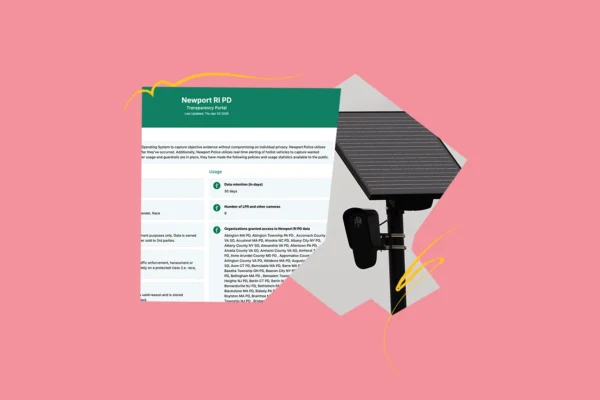
First, what is a “Transparency Portal”? Flock Safety, a brand of automated license plate reader (ALPR) cameras, offers publicly published webpages with data to police departments that have a Flock Safety contract. These portals offer some information about Flock Safety data use in the last 30 days, including (but not limited to):
- Number of cameras the police department has
- Number of vehicles that have been detected in the last 30 days
- Number of search sessions by the law enforcement agency
- Number of hotlist hits (e.g., Amber Alerts)
Why is this information important? Outside of filing public records requests, which takes time and money and provides quickly outdated datasets, the information on these portals is the only way we have of knowing how much information is being collected and used in each department, and how far outside of Rhode Island the data being collected is going.
But some police departments have not jumped on the opportunity to be transparent with their communities. In Tiverton, the police department did not even activate their transparency portal — which is required by their departmental policy — until we pointed out to them that it wasn’t live. Coventry has cameras but simply has not published a portal, and Narragansett recently terminated their contract with Flock Safety, but during the few active years, the police department never established a portal.
This is a very basic level of transparency that all police departments using Flock Safety technology should provide for the public.
Part 2. Difficulty Finding Transparency Portals
In May 2026, we noticed that when we Google-searched to find a city or town’s transparency portal — searching for something like “flock transparency portal east providence ri” — the links to Flock Safety’s transparency portals stopped showing up on first page results of the search. Or even the sixth page.
We know these links existed, because we had visited the portal pages of local police departments and used the information included on them before. But now, unless we had a direct link already saved, or the municipality’s police department decided to share the link on their website, which is rare, we could not find the transparency portal. (The irony of the name is not lost on us!)
Because we no longer were able to rely on search results, we began manually editing — guessing, you could say — the transparency portal URLs to find them. All the portals are versions of “transparency.flocksafety.com/[city name]-ri-pd”. For example, we found Smithfield’s portal by going to: “transparency.flocksafety.com/smithfield-ri-pd”
We can only speculate as to the reason for this difficulty in finding links to the portals through searches, but it certainly suggests a concerted effort by unknown parties to suppress the search engine optimization results for them.
An Extra Hurdle
While we haven’t been able to recreate the issue recently, back in May after editing the URL several times in a row, we began to receive an error message that we were being rate limited. This meant we were temporarily banned from accessing any Flock Safety portals for 24 hours.
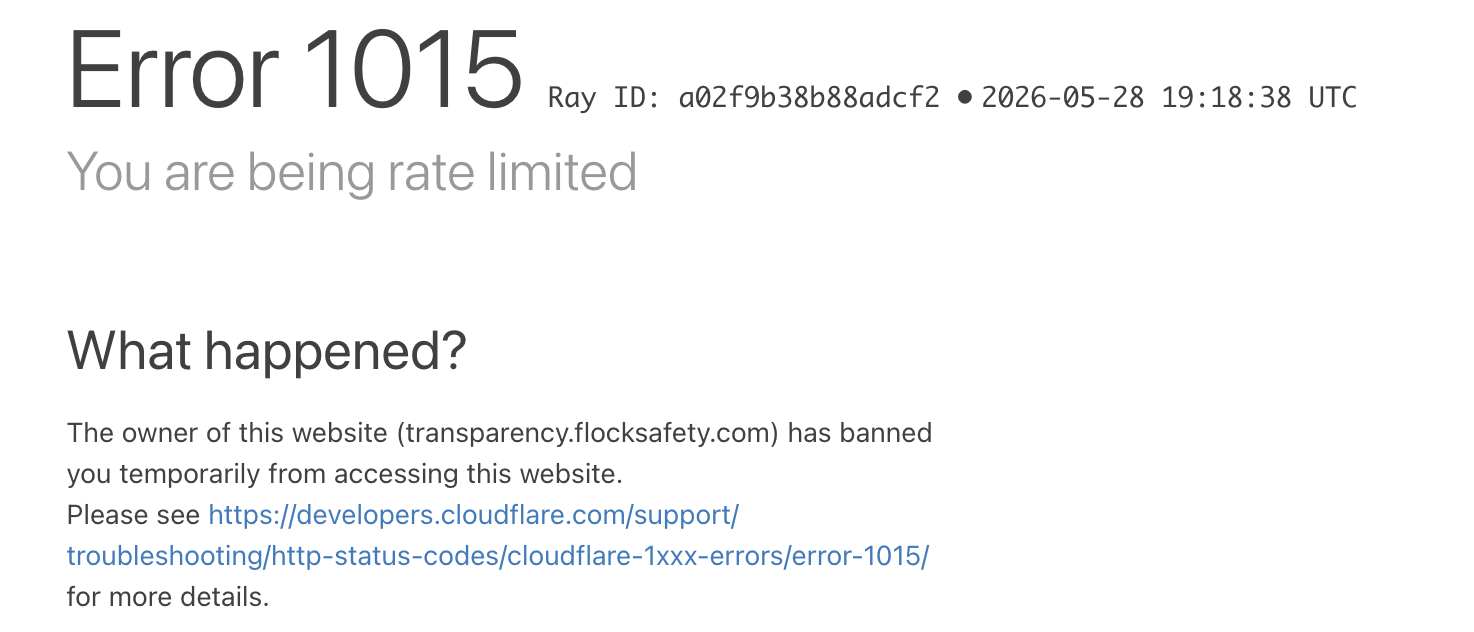
While we understand this may be a standard protocol to avoid bots or other attempts to overwhelm their servers, and we could switch to using cellular data rather than using wifi, as the ban was based on our office’s IP address, it was another hurdle on top of manually searching in the quest for accessing transparency. Flock Safety was not making it easy to find, or share, the portals.
Part 3. Cities and Towns’ Lack of Transparency
Fast forward to August of 2026. Four Rhode Island towns had chosen to terminate their contracts with Flock Safety. We then noticed that three departments using Flock Safety had no transparency portal available, and of the 18 Rhode Island municipalities that we knew had posted transparency portals, eight of them did not list which other police departments or other agencies they shared their information with.
These are the municipalities that have a transparency portal, but do not list what agencies they share information with (as of August 28, 2026):
- East Providence
- Johnston
- Newport
- North Kingstown has since canceled contract, still has portal
- North Providence
- Pawtucket
- Smithfield
- South Kingstown has since canceled contract, still has portal
These municipalities do not have a transparency portal (as of August 28, 2026):
- Coventry
- Glocester has since canceled contract
- Narragansett has since canceled contract
In at least one instance, we know of a police department that had been sharing this information on their portal but then stopped doing so. We have screenshots from Newport’s portal from April 2026 that show the literally hundreds of police departments across the country that, at that time at least, had access to Newport’s data. That information is no long included on Newport’s portal.
Again, the information on these portals is the only way we have of knowing how far outside of Rhode Island our data is going.
We also know that municipalities like Tiverton and Woonsocket share data with states across the country, from New York to Ohio to Texas, and some police departments in those states share the data with federal agencies like ICE.
Many local police departments have also decided not to list other information they have the opportunity to include on their portal. Just as some departments don’t publicize what outside agencies they allow to access their Flock Safety data, even more fail to list the communities whose data they can access. For example, when Warwick searches for a license plate, we don’t know how many other police department cameras in other states are also providing data to Warwick.
Flock Safety also allows police departments to publicly post “audit logs,” which detail the searches that have been conducted and the reason offered for conducting the search. We found only two departments – Foster and Newport – sharing that information.
The takeaway: Rhode Island’s police departments have a lot more opportunities to share data about their Flock Safety system than they take advantage of. If they are going to use these intrusive surveillance devices, they should be making use of the transparency portals provided them by Flock and posting all available information.
Bonus portal additions we appreciate: Foster and Newport both include what agencies they receive data from. (We still think Newport should still include who they share with, though.)
Part 4. Flock Safety Attempts to Erase History
To try to compare the information currently appearing on police department transparency portals with how they looked in the past, we turned to the extremely helpful internet tool known as the Wayback Machine. The Wayback Machine is a part of the Internet Archive project, which allows you to see snapshots of millions of websites as they looked days, months, and years ago.
We were in for a surprise: The Wayback Machine has no record of Flock Safety transparency portal websites at all — in Rhode Island or elsewhere. Even more shocking, it has no archived records capturing Flock Safety’s own website and how it has been revised over the months and years. This means we can’t go back to see how the company has changed its privacy statements and descriptions of their surveillance technology over time — changes that we know have routinely occurred.
After researching further, we learned from a report that Flock Safety had “excluded its website from the Internet Archive’s Wayback Machine, the most widely used public tool for tracking how a company’s claims, promises, and legal commitments change over time.”
The takeaway: Flock Safety is intentionally preventing concerned citizens and watchdog organizations from seeing how their company and offerings change and how police department transparency portals evolve over time.
Talk about being supposedly the “most transparent.”
In Conclusion — What We Can Do
We’re doing our best to keep track of Flock Safety, and other ALPR camera companies like Axon, across the state. If you care about privacy and government transparency, you can:
- See what your city or town’s transparency portal looks like, if your community has Flock cameras and has a portal. Find our list of transparency portal links on our website here.
- If your community has a portal that is lacking pieces of information, contact your police department and request they add as much information as they can to it and post a link to the portal on the police department website.
- Reach out to your city or town council to oppose automated license plate reader contracts, with Flock Safety or any other company. Four municipalities have already done so in the past month thanks to public outcry: Glocester, Narragansett, North Kingstown, and South Kingstown.
- During the Rhode Island legislative session, keep an eye out for legislation to regulate ALPR cameras (of all brands!). We’ll let you know about it, if you follow our social media or sign up for our emails.
Plus, if you see anything about Flock Safety, Axon, or other surveillance cameras on your local council’s agenda, please send us a quick email to let us know!