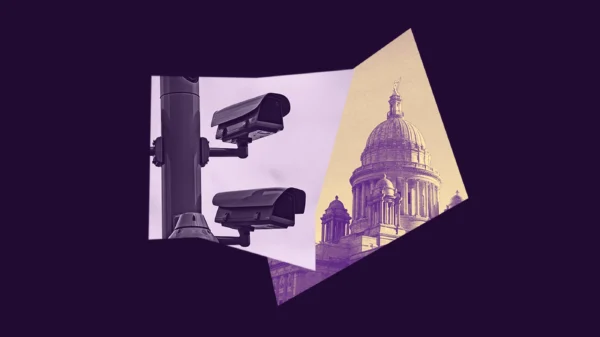
Imagine you start a new birth control. You’ll probably use your phone to research different types of birth control options, open a GPS app to route your travels to go to an appointment with a health care provider to talk about it, or update a period-tracking app with your symptoms. While what happens in your doctor’s office is private and confidential under the Health Insurance Portability and Accountability Act of 1996 (HIPAA), all the other data that’s collected about you — what you’re reading online, and where you’re going — can be collected by private companies. This data can be used to infer your health care decisions, like if you’re seeking reproductive or gender-affirming health care and sold to other companies.
Across the country, we are facing attacks on our right to safe, legal health care — abortion, gender-affirming care, and even birth control that helps us have healthy and self-determined lives.
In fact, a lot of our personal health care decisions can be tracked based on technology, through the phones we carry with us or license plate reader cameras that track us when we drive through the state. That’s why we support bills H 7357 & S 2992 and H 8077, to protect our data privacy, prevent third-party companies from collecting, using, and selling our data that relates to reproductive and gender-affirming health care decisions, and restrict the use of police surveillance cameras.
What do these bills do?
- Require entities like private companies to obtain explicit consent from users before collecting or sharing any data that is related to reproductive or gender-affirming care decisions.
Example: If you buy pre-natal vitamins, you will have to consent to the collection and sharing of that information - Limit the collected data to only what’s necessary to provide the services you’re receiving from the company.
Example: If you use an exercise app that tracks your heart rate and the distance you run, that is data that you’re asking the app to collect. However, if this bill passes, the app, couldn’t then turn around and use that data for the purposes of inferring reproductive or gender-affirming health care information about you. - Bring our privacy protections into the 21st century by prohibiting companies from creating a geofence — a virtual boundary that can track when someone’s smart phone crosses in or out of an area — around healthcare facilities that provide reproductive or gender-affirming services.
Example: Using a geofence to determine which individuals are is going to a clinic, like at Planned Parenthood. - Creates safeguards around the use of police surveillance cameras, specifically automated license plate readers (ALPRs).Nearly 300 ALPR cameras made by the brand Flock Safety have already been put up throughout Rhode Island — and they capture a lot more information than just license plates. Flock Safety cameras take a photo of the back of every single car that passes them. Unlike a red-light camera or a speed camera, you don’t have to break a law to have your picture taken (these cameras don’t even track speed.) Photos are then uploaded to a database that, if the police department opts-in, is shared with other law enforcement agencies across the state, and makes your vehicle searchable by make, model, color, and even details like dents or bumper stickers.Example: A woman in Texas was tracked by police via Flock Safety cameras because she was suspected of self-administering an abortion.
How does this affect reproductive health care?
The combination of the wide surveillance network of cameras and nationwide sharing capabilities raise red flags for issues like reproductive freedom. If someone from a state that restricts access to reproductive health care or gender-affirming health care travels to Rhode Island to seek this care, data about them collected by ALPR cameras could be accessed from their state of origin and weaponized against them. (Similarly, Flock Safety systems have been used by ICE to find and target people.)
These cameras remain virtually unregulated in Rhode Island, as we currently have no state laws and very few meaningful municipal ordinances that govern the installation and use of these cameras.
The need for these protections is more urgent than ever. Even though Rhode Island has protections for individuals seeking reproductive health care and gender-affirming health care, these bills would add another level of privacy protection and ensure third-party companies do not collect and misuse our data, and our movements are not traceable through law enforcement.
Nobody should be afraid of seeking essential health care because they’re afraid of being tracked or surveilled.
This blog is a collaboration with Planned Parenthood Votes! Rhode Island Learn more: Planned Parenthood Votes! Rhode Island