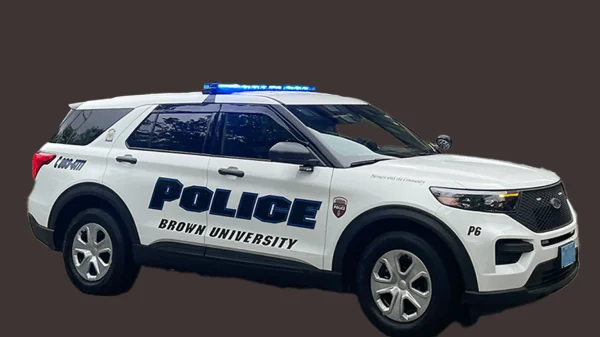
In a court ruling issued today, Rhode Island Superior Court Associate Justice Shannon Signore rejected Brown University’s attempt to dismiss a lawsuit contesting Brown University police department’s refusal to provide copies of its arrest reports, instead ruling that the lawsuit should proceed for full development on the merits. The lawsuit, filed by ACLU of RI cooperating attorney Fausto Anguilla, centers on whether Brown’s police department is subject to the state’s Access to Public Records Act (APRA).
The lawsuit was filed last June against Brown University’s Department of Public Safety (BDPS) on behalf of two journalists after BDPS refused to provide them reports of arrests made by BDPS officers. In one instance, Noble Brigham, who was then a Brown Daily Herald reporter, was denied access to the arrest reports of a man who had been charged multiple times by BDPS with trespassing and breaking and entering on the Brown campus. In the second instance, Motif Magazine reporter Michael Bilow was denied the BDPS police reports on 41 Brown University students who were arrested for trespassing after protesting university investment practices and refusing to leave a university building after hours.
Noting that APRA explicitly applies to private agencies that are “acting on behalf of and/or in place of any public agency,” the suit claims that BDPS clearly meets that definition. The suit notes that “BDPS police officers are sworn law enforcement officers and are explicitly vested with the same powers and authority that are vested in a state or municipal police officer”; they are appointed by the state police superintendent; they are explicitly designated by state law as “peace officers” with the power to arrest people; and, in Brown’s own words on its website, they “have police jurisdiction on campus and upon the streets and highways adjacent to the campus.”
Notwithstanding these facts, Brown University filed a motion to dismiss the case, arguing both that the case was moot and that APRA did not apply to a police department like BDPS. It was that motion which Associate Justice Signore denied today. As a result, the case will proceed for further consideration.
Steven Brown, executive director of the ACLU of RI, stated today: “We believe it is clear that the Brown University Police, with the power that they wield, should be as transparent and open as any other police department. We’re pleased that the court agreed that this case raises important legal issues that cannot be easily dismissed.” A copy of case documents can be found here.